Style
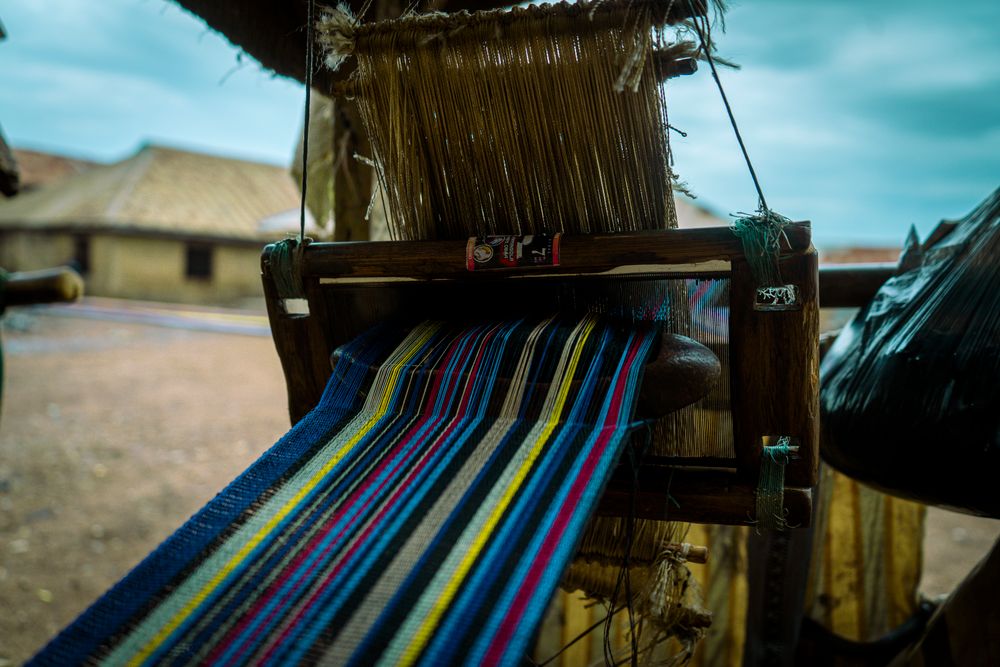
Kente is not a fabric. It is an archive.
Woven narrow on purpose: the pattern names record proverbs, births and grief.
Read the piece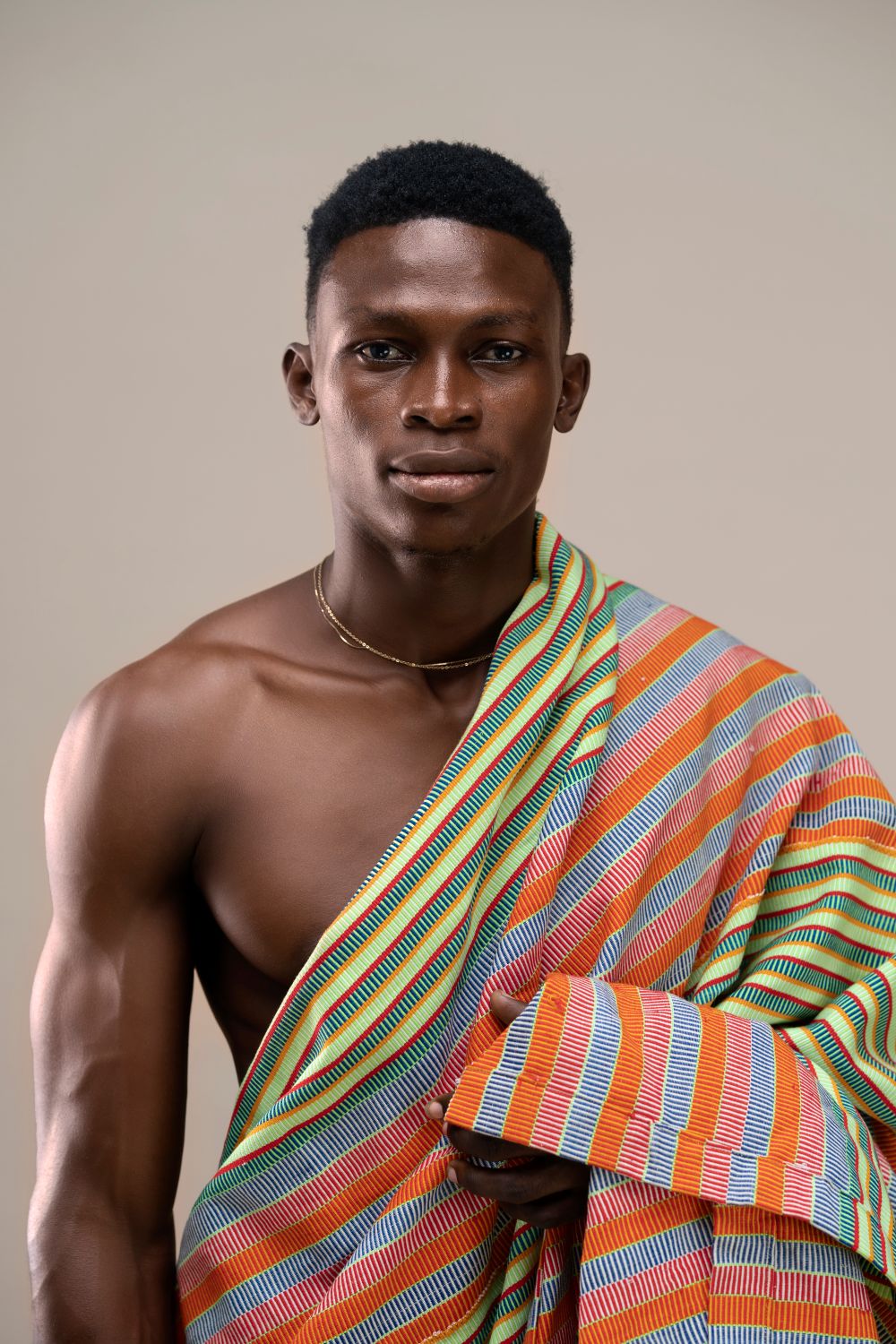
You have seen adinkra this week, almost certainly. On a ring, a phone case, a pair of trainers, a tattoo, the border of a dress. The symbols travel better than the meanings do, and that is the whole problem with how the world learned to wear them.
Start with the technique, because it explains the look. Adinkra cloth is made by stamping. A stamp — traditionally a piece of calabash with the symbol carved into it, backed with a stick handle — is dipped into a thick black dye and pressed onto cotton in a grid. The grid is ruled first with a comb-like tool, so the finished cloth reads like a page: rows, columns, and a repeating cast of characters.
The dye comes from the bark of the badie tree, boiled down until it is dark and glossy. In the older cloths the only colour was that black, which is why adinkra belongs so completely to funerals — it is mourning cloth, worn to bid farewell, and the palette said so before any symbol did. Modern adinkra cloth is stamped in several colours and worn to weddings and naming ceremonies too, but the mourning association has never gone away, and it is the reason some Ghanaians wince when they see the symbols used as decoration on a beach towel.
The name is usually explained as a parting. Adinkra is glossed from Akan as a message sent, or a goodbye — di nkra, to bid farewell — which is exactly what the cloth is for. The account most often repeated by weavers and historians runs like this: a ruler of Gyaman, in what is now the north-east of Côte d'Ivoire, was defeated by the Asante in the early nineteenth century, and the printed cloth he wore was taken as spoil. The craft took hold in Asante workshops and spread from there.
Treat that as the popular account rather than the last word. The symbols themselves are older than the cloth: they appear on goldweights, on the tops of ceremonial umbrellas, on stools and on the walls of buildings, long before anyone was stamping them onto fabric. What the cloth did was give the symbols somewhere to repeat — a surface for the same proverb to appear forty times over, so that a person wrapped in adinkra is walking around inside a text.
There are hundreds of adinkra symbols. These are the ones that have travelled furthest, with the value each one encodes — because a symbol without its proverb is just a nice shape.
| Symbol | Name means | The value it carries |
|---|---|---|
| Adinkrahene | Chief of the adinkra symbols | Leadership, greatness, charisma — the mark of the one who sets the standard others follow. |
| Gye Nyame | Except for God | The supremacy of God. Probably the most widely worn of all, and the one most often seen floating free of any cloth. |
| Sankofa | Go back and fetch it | Learn from the past. Drawn as a bird reaching back for the egg on its own back — you can only take what you turn around for. |
| Dwennimmen | Ram's horns | Humility alongside strength. The ram fights hard and still bows its head to be led. |
| Nkyinkyim | Twisting | Adaptability, initiative, dynamism — for when the road will not go straight. |
| Nkonsonkonson | Chain links | Unity and community. A single link is weak; the same link inside a chain is not. |
| Aya | Fern | Endurance. The fern grows where the ground is poor, which is the point of the proverb. |
| Akoma | Heart | Patience, tolerance, faithfulness — taking the long view in a disagreement. |
| Eban | Fence | Security and safety: the boundary that a home has around it, and the love that keeps it standing. |
| Fihankra | Compound house | Brotherhood and solidarity — the walled compound with one gate, entered together. |
| Pempamsie | Sew in readiness | Readiness and unity in strength. The link that has been sewn through cannot be pulled apart. |
| Nsaa | A hand-woven cloth | Excellence and authenticity. The proverb is blunt: the person who does not know real nsaa will buy the imitation. |
One more is worth knowing because it escaped the cloth entirely. Akoma Ntoso — linked hearts, for understanding and agreement — is now the name of the document format that several parliaments and the United Nations use to publish legislation in machine-readable form. A symbol for agreement became the standard for publishing the law. That is the cleanest proof available that these are not decorations. They are vocabulary.
Three things dilute adinkra, and only one of them is anybody's fault.
The first is scale. When a symbol is printed onto ten thousand keyrings, the grid that gave it rhythm disappears, and with it the sense that the wearer chose it. Nobody picks a proverb off a novelty keyring; they pick a shape.
The second is the honest gap in knowledge. A great many people of African descent who are not Akan wear adinkra as pan-African shorthand — a Ghanaian script standing in for a continent — and can name perhaps two of the symbols. Whether that is adoption or appropriation is an argument Ghanaians are having among themselves, and it does not resolve neatly. The Asante tradition is not sealed: it has always moved through trade, marriage and migration. What it asks for is not permission so much as attention.
The third is manufacturing. Mass-produced adinkra-print fabric, often printed abroad, has undercut the stampers at Ntonso, the town near Kumasi where the cloth has been made by hand for generations. That is not a question of taste. It is a trade that either has customers or does not.
Practical advice, then. Look for the grid: if the symbols repeat in ruled columns, you are probably looking at stamped cloth rather than a print. Look for the irregularities — a hand-cut calabash stamp leaves edges that a printer never does. Then ask the wearer. Adinkra was designed to be explained; a symbol worn in silence is doing half its job.
Pride that cannot name what it is proud of is only decoration.
This piece sets out the meanings as they are taught by Akan scholars and the stampers at Ntonso. Glosses vary between families and between workshops, and we have given the version most widely used rather than pretending there is only one. If we have got a name or a proverb wrong, write to the Culture Desk — we correct in the open, at the foot of the piece.
Keep reading
Woven narrow on purpose: the pattern names record proverbs, births and grief.
Read the piece
A language that survives only in greetings and in church is already half gone.
Read the column
Credit history that does not transfer, suppliers in another time zone, customers on two continents.
Read the guide